Building an admin dashboard from scratch takes weeks. The sidebar, the charts, the tables, the forms, the login pages, and the dark mode toggle all land before the first real feature. A dashboard template hands that groundwork over as ready-made code, so you wire it to a Laravel backend and move straight to the features that matter.
ThemeWagon builds frontend templates for this exact stage, and several of them support Laravel. The connection differs from template to template, though. A few ship a dedicated Laravel version with Blade files and a Composer setup, so you install and run them as a Laravel app from the start. Most arrive as HTML, Bootstrap, or React code that you port into Laravel’s Blade views or connect through an API. That difference sets how much setup work waits in front of you.
A good template comes down to the basics: clean code, a clear file structure, responsive layouts, and updates that keep arriving. This list covers seven paid options. The first four come from ThemeWagon, followed by three alternatives that developers reach for often. Each entry breaks down the features, the price, the honest pros and cons, and the steps to get it running in Laravel.
Quick Comparison of the Best Laravel Dashboard Templates
After reviewing more than a dozen paid dashboard templates, these seven came out on top.
| Template | Framework / Type | Laravel Version | Price | Integration Effort |
|---|---|---|---|---|
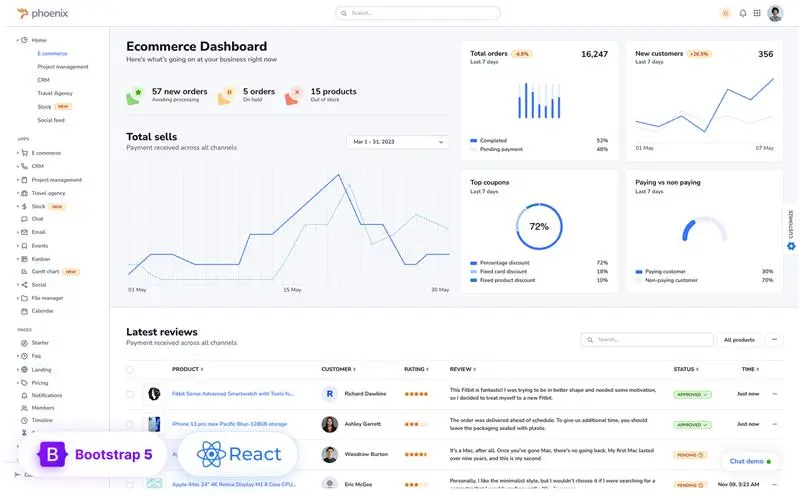
| Phoenix | Bootstrap 5 (HTML) | Laravel-ready | $59 | Low to moderate |
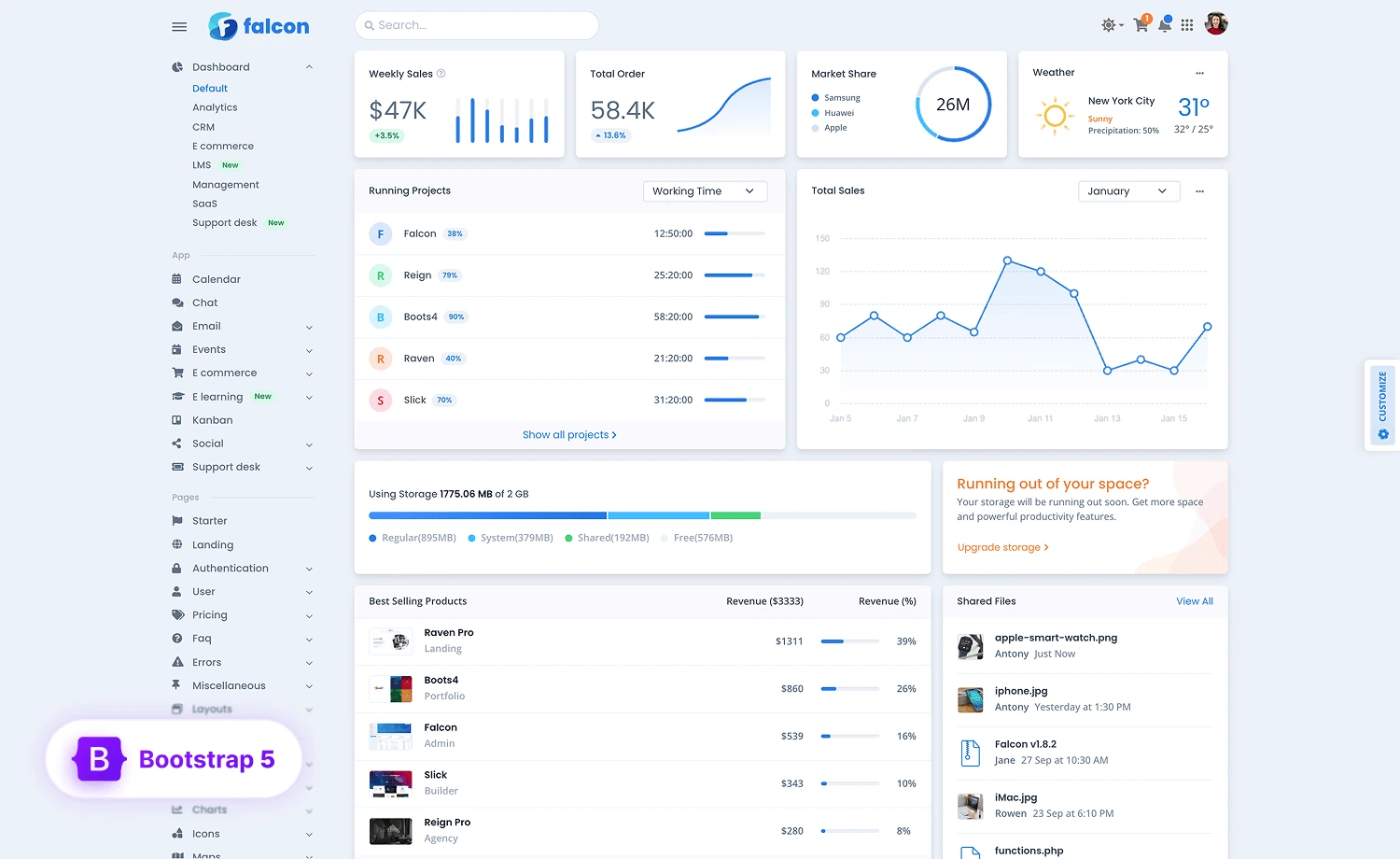
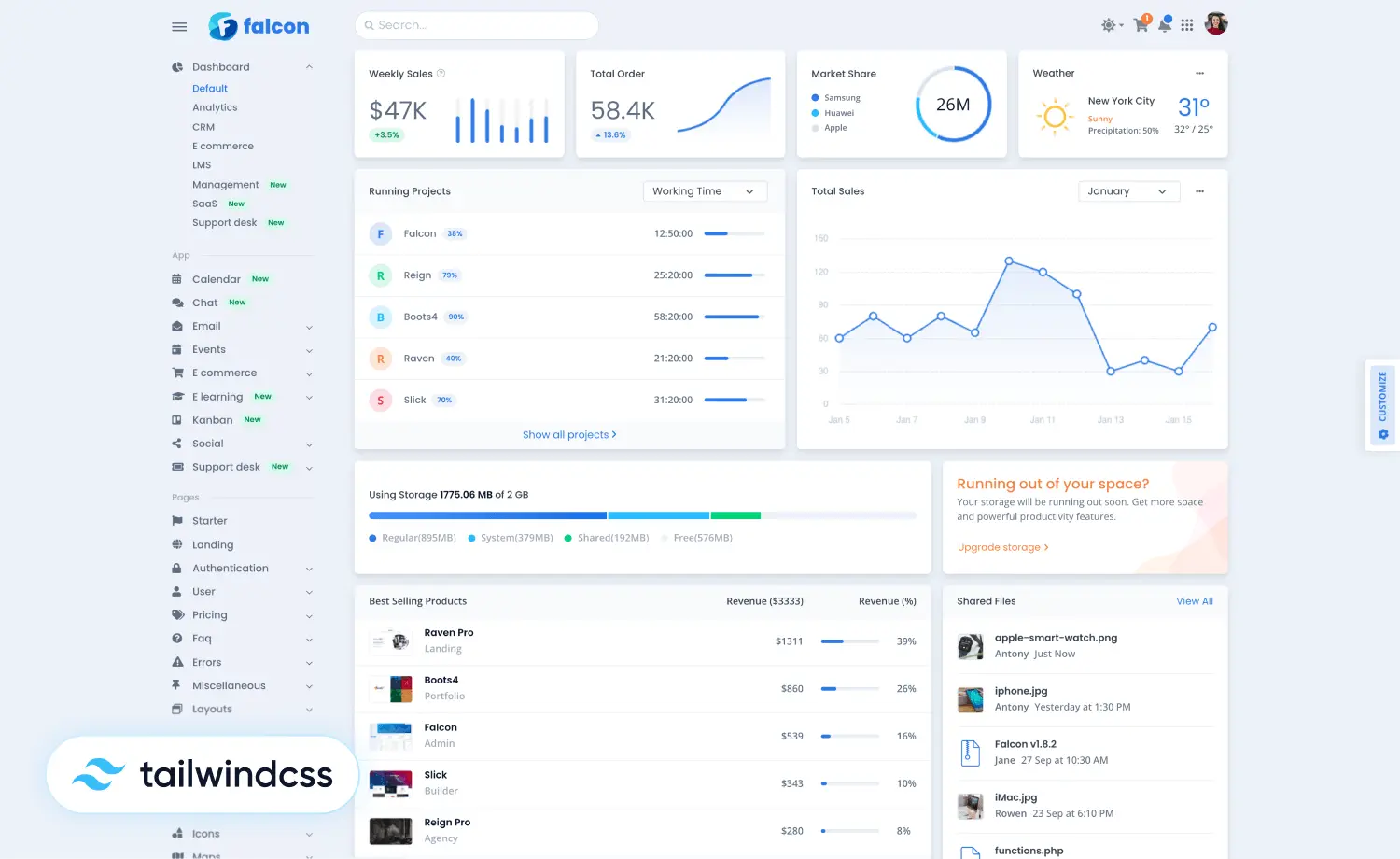
| Falcon | Bootstrap 5 (HTML) | Laravel-ready | $59 | Low to moderate |
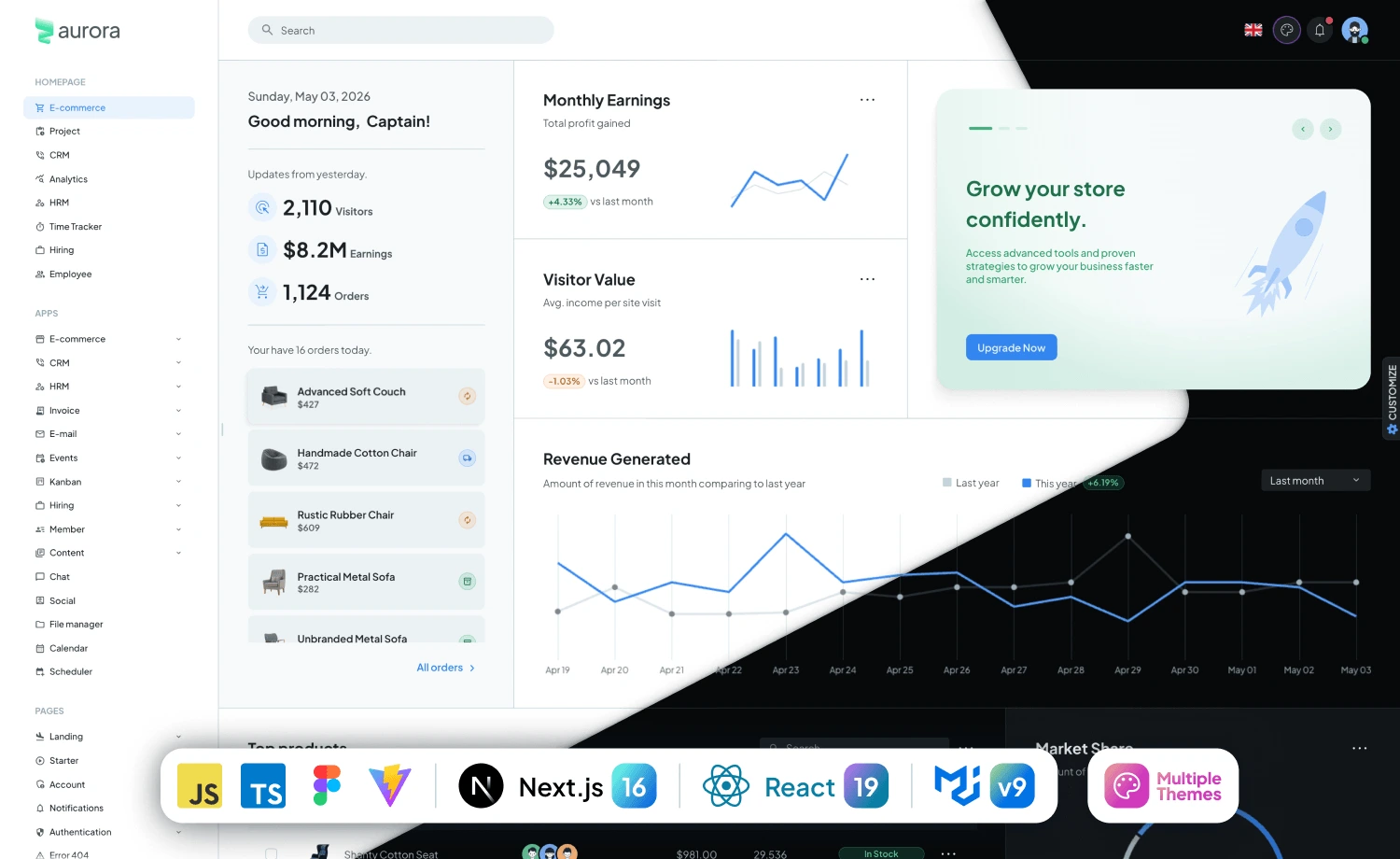
| Aurora | React, Material UI | API or Inertia | $59 | Moderate |
| Falcon React | React, Bootstrap 5 | API or Inertia | $59 | Higher |
| Metronic | Multi-framework | Ships Laravel version | $49 | Low (Laravel build included) |
| Vuexy | Multi-framework | Ships Laravel 12 version | $39 | Low (Laravel build included) |
| MaterialPro | Bootstrap 5 (HTML) | Laravel-ready | $49 | Low to moderate |
Best Laravel Dashboard Templates Reviewed
A closer look at all seven, starting with ThemeWagon’s four and then the three alternatives. Features, pricing, and the Laravel setup sit under each one.
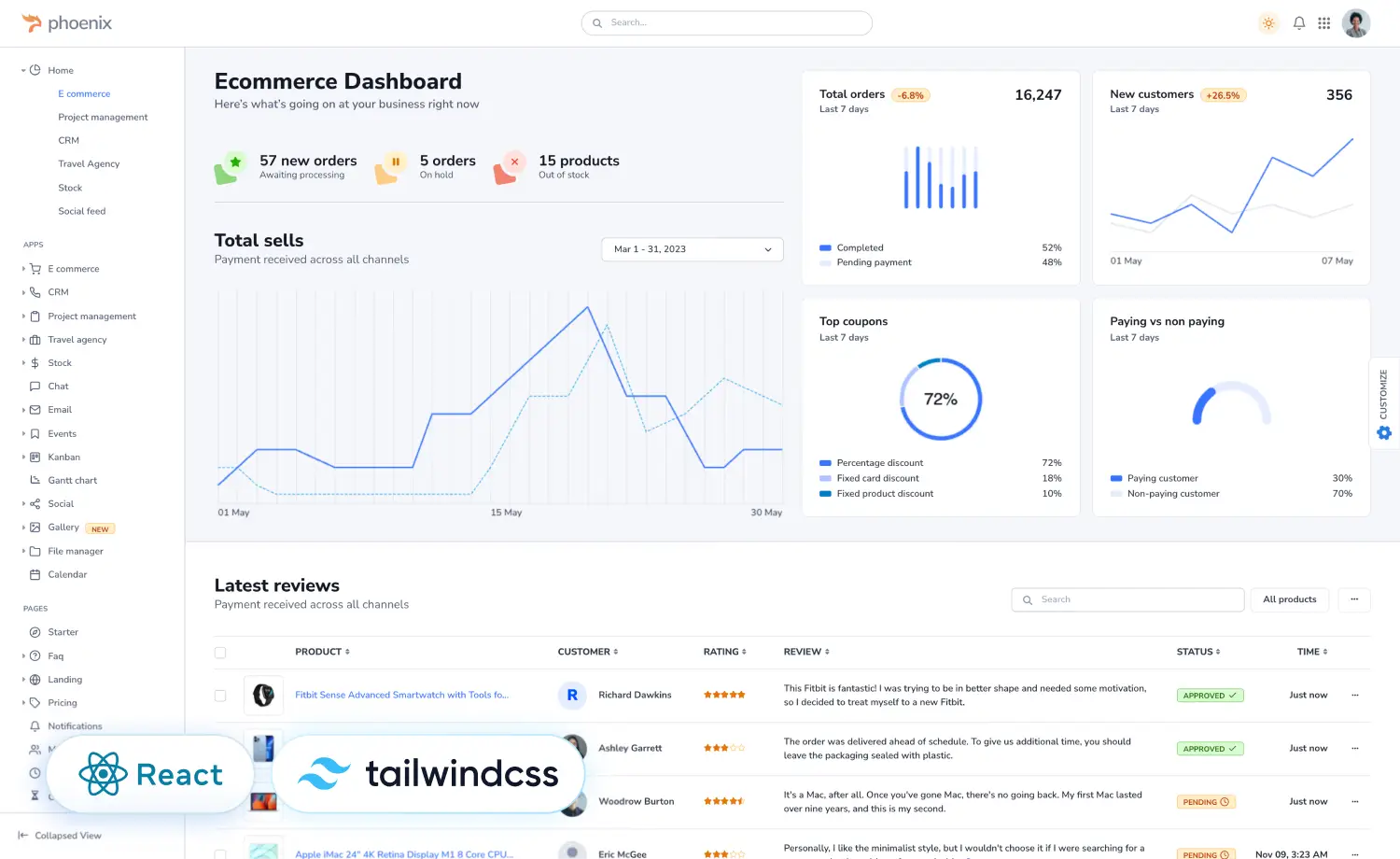
1. Phoenix
Overview
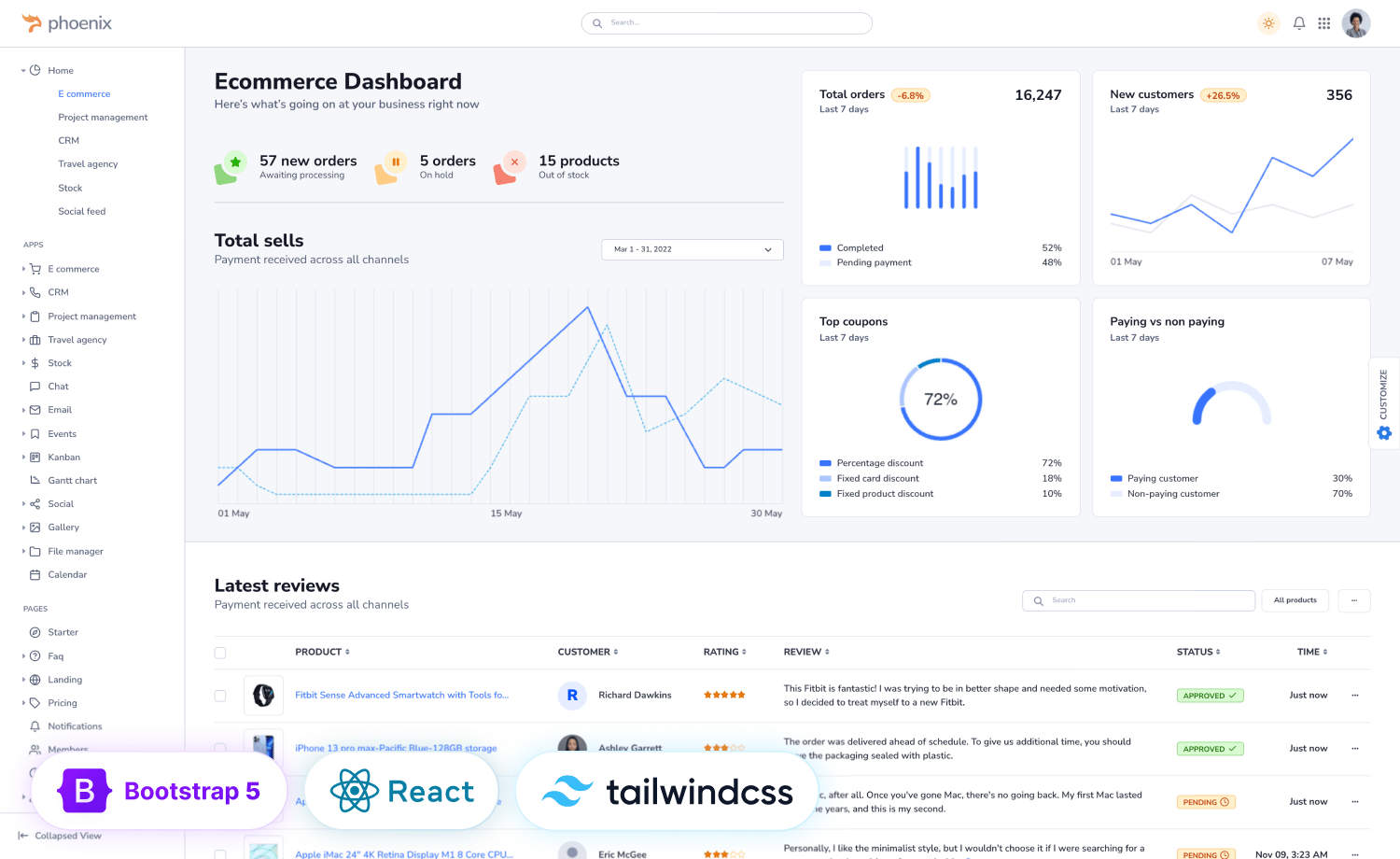
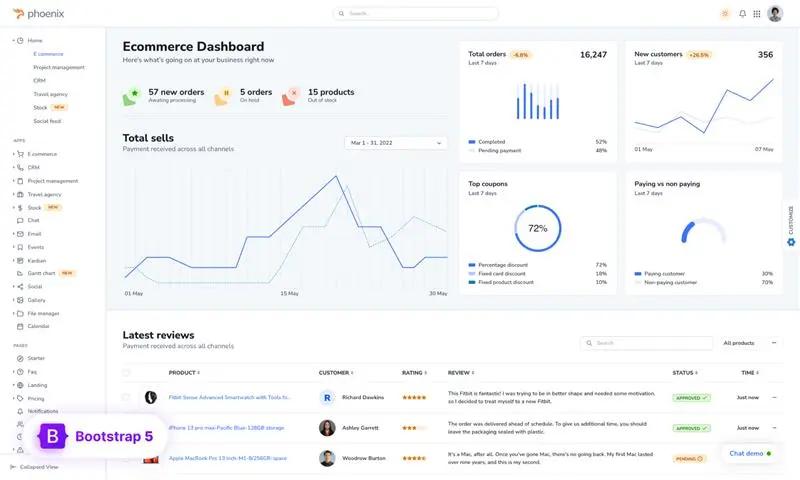
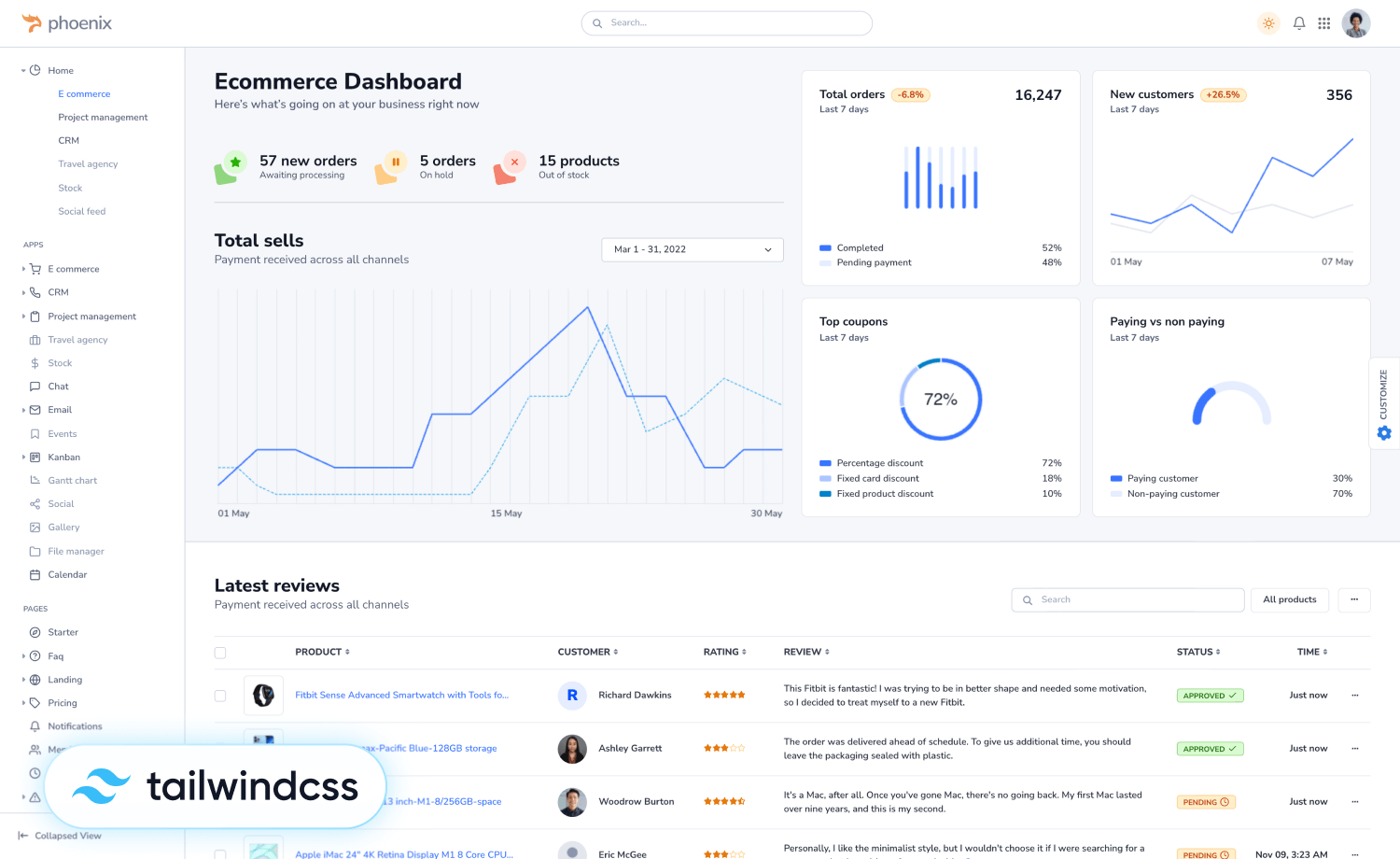
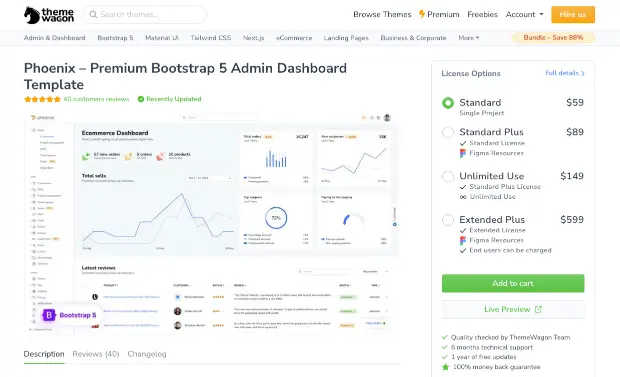
Phoenix is a Bootstrap 5 admin and web app template from ThemeWagon.
It ships 216 HTML files, 10 layouts, 14 prebuilt apps, and a Gulp-based workflow, with no jQuery dependency. The product page lists Laravel among its supported frameworks, and the template has passed 5,000 purchases. ThemeWagon’s Phoenix 101 walkthrough covers the layout and structure in detail.
Features
- Bootstrap 5.3.x, HTML5 and CSS3, no jQuery
- 10 layouts, including vertical sidenav, collapsed sidenav, horizontal navbar, combo nav, and dual nav
- 14 apps, including ecommerce, CRM, project management, Kanban, stock, and Gantt chart
- 8 modules, 27+ components, and 17+ utilities
- Light and dark modes, RTL support, and multilevel dropdown menus
- Authentication pages: sign-in, sign-up, forgot password, and reset password
- File manager, calendar, gallery, grid and list views, FAQ pages, and error pages
- Prettier formatting, SCSS codebase, W3C-validated pages, and Figma files included
Price
$59 for the Standard license, which covers a single project. Higher tiers add Figma resources, unlimited use, and extended rights for end products.
Pros and Cons
How to integrate into Laravel
Phoenix arrives as Bootstrap HTML, so you port it into Laravel’s Blade view layer. Blade is Laravel’s templating engine. Follow these steps:
- Copy the CSS, JavaScript, fonts, and images from the Phoenix public folder into your Laravel public directory, or wire them through Vite, Laravel’s asset bundler.
- Create a master Blade layout for the shared header, sidebar, and footer.
- Split each Phoenix page into Blade views that extend the master layout with @yield and @section.
- Replace static file paths with Laravel’s asset() or @vite() helpers.
- Swap the static demo content for Blade variables and loops that pull from your database.
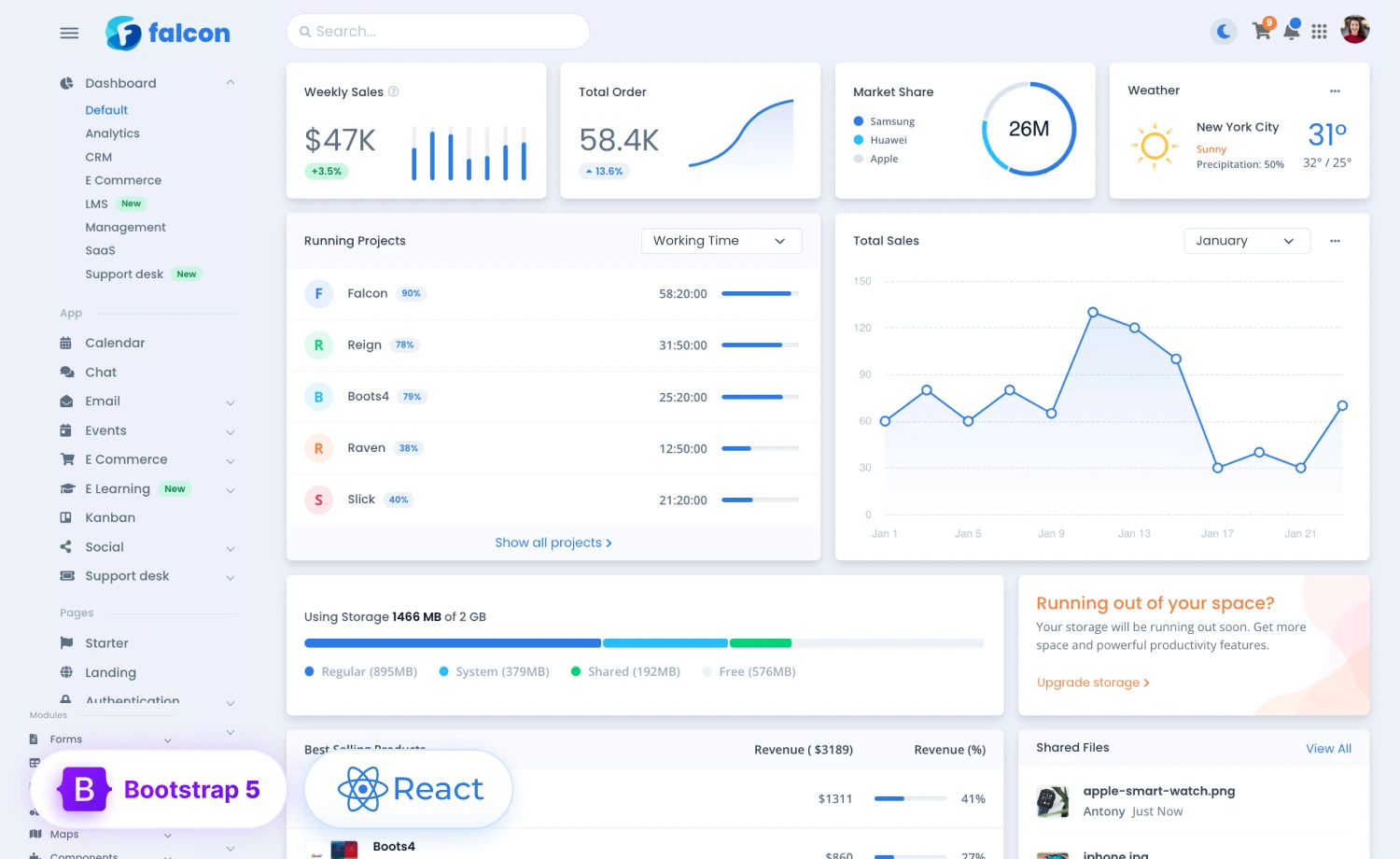
2. Falcon
Overview
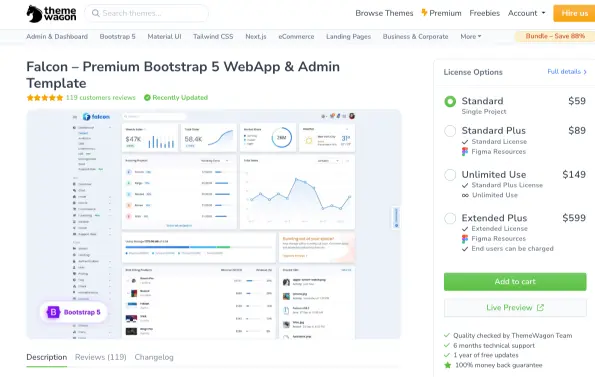
Falcon is a Bootstrap 5 web app and admin template from ThemeWagon.
It carries 211 HTML files, more than 100 UI components, and 9 prebuilt apps. An optional Gulp workflow sits alongside precompiled HTML, so you build from source or use the ready pages in the public folder. Falcon has passed 6,000 purchases, and ThemeWagon’s Falcon 101 overview breaks down the components and pages.
Features
- Bootstrap 5.3.x, HTML5 and CSS3
- 100+ UI components, 35 plugin sets, and 17+ utilities
- 9 apps, including ecommerce, e-learning, calendar, email, chat, and Kanban
- 9 modules, authentication pages, file manager, and basic and advanced tables
- Light and dark modes, RTL support, four navigation styles, and fluid and classic layouts
- 1,512 SVG icons and four icon sets: FontAwesome, Bootstrap, Feather, and Material
- SCSS codebase, Figma files, and precompiled HTML for direct use
Price
$59 for the Standard license, which covers a single project. The same tier structure as Phoenix applies, with Figma, unlimited use, and extended options at higher prices.
Pros and Cons
How to integrate into Laravel
Falcon ships ready HTML in its public folder, which shortens the first step, since you start from plain HTML without running the build. The path follows the same Blade approach as Phoenix:
- Move the public-folder assets into Laravel’s public directory, or route them through Vite.
- Build a master Blade layout for the header, sidebar, and footer.
- Split the HTML pages into Blade views that extend the layout.
- Replace asset paths with asset() or @vite() helpers.
- Bind the dashboard data through Blade variables and loops.
3. Aurora
Overview
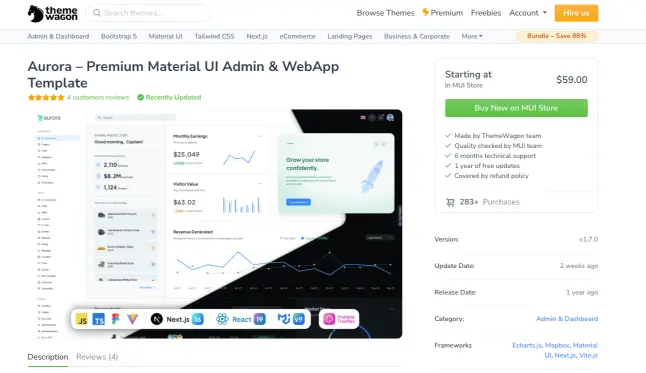
Aurora is a Material UI admin and web app template from ThemeWagon, built with React 19, MUI v9, React Router v7, and Vite.
It includes more than 100 pages, 10 prebuilt apps, and authentication through JWT, Firebase, Auth0, and social login. Aurora has 280+ purchases and is a React template rather than HTML or Bootstrap. For more React and Material UI options, browse ThemeWagon’s premium admin dashboards.
Features
- React 19, Material UI v9, React Router v7, and Vite
- 100+ prebuilt pages, 8 homepage layouts, and 10 apps such as ecommerce, chat, Kanban, email, file manager, calendar, and invoice
- 50+ customized MUI components and 100+ widgets
- Authentication with JWT, Firebase, Auth0, and social login
- Form handling with React Hook Form and Yup, plus data fetching with SWR and Axios
- ECharts charts, Mapbox maps, Tiptap editor, i18next localization, and drag and drop with Dnd Kit
- Light and dark modes, RTL support, and multiple navigation styles
Price
$59 in the MUI Store. The price includes 6 months of technical support and 1 year of free updates.
Pros and Cons
How to integrate into Laravel
Aurora is React, so Laravel runs as the backend rather than rendering the views. Two common paths apply:
- API approach: Laravel exposes REST endpoints and handles authentication with Sanctum, Laravel’s token-based API authentication. The Aurora React frontend reads those endpoints through Axios.
- Inertia approach: Inertia.js connects Laravel routes and controllers to React pages without a separate API layer. You return Inertia responses from Laravel and render Aurora’s React components.
4. Falcon React
Overview
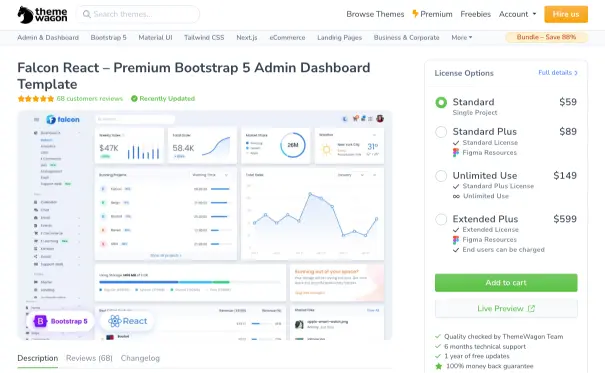
Falcon React is the React version of Falcon, built with Bootstrap 5.3.8, React 19, React Router 7, and TypeScript, with no jQuery dependency.
It carries more than 100 UI components and 9 apps, and includes a Next.js starter on request. Falcon React has passed 2,500 purchases, and ThemeWagon’s Falcon React guide walks through the React version.
Features
- React 19, React Router 7, React-Bootstrap, and TypeScript, with no jQuery
- Bootstrap 5.3.8 styling, 100+ components, 35 plugin sets, and 17+ utilities
- 9 apps, including ecommerce, e-learning, calendar, email, chat, and Kanban, plus an LMS page
- Built-in React packages: Chart.js, React Table, React Datepicker, React Select, React Toastify, and Dnd Kit
- Light and dark modes, RTL support, and four navigation styles
- ESLint, Prettier, ECharts, React Context for state, and Figma files
Price
$59 for the Standard license. The tier structure matches Falcon, with Figma and extended options at higher prices.
Pros and Cons
How to integrate into Laravel
Falcon React uses the same two React paths as Aurora. Laravel exposes a REST API with Sanctum and the React frontend reads it through Axios, or Inertia.js bridges Laravel routes and React pages without a separate API. Pick the API route for a fully separate frontend, and Inertia for tighter coupling between Laravel and React.
5. Metronic
Overview
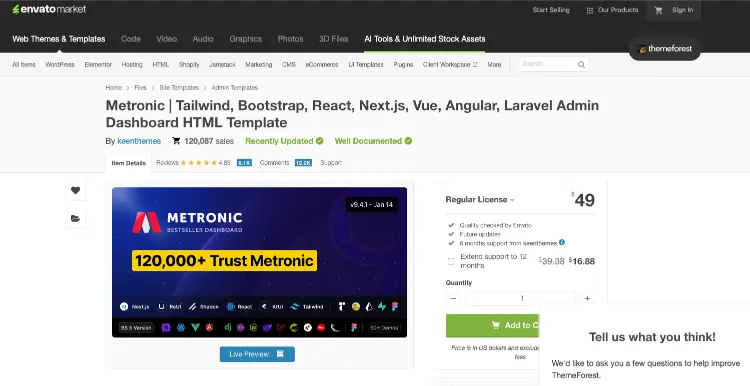
Metronic is a multi-framework admin template by KeenThemes on ThemeForest, with versions for Tailwind, Bootstrap, React, Next.js, Vue, Angular, and Laravel.
The Laravel build uses Bootstrap 5 and ships ready to install. Metronic has passed 120,000 sales and was last updated in June 2026. For related options across frameworks, see Technext’s roundup of webapp and admin templates.
Features
- Versions for Tailwind, Bootstrap 5, React, Next.js, Vue, Angular, and Laravel
- 1,000+ UI elements and 60+ components in the Tailwind toolkit, plus 40 prebuilt layouts
- Dark mode, RTL support, and a multi-demo structure
- Prebuilt apps and dashboards for CRM, ecommerce, and project workflows
- PHP, HTML, CSS, Sass, SCSS, and JS files included
- Documentation for the Laravel setup
Price
$49 for the Regular license on ThemeForest, which covers a single end product where end users are not charged. The Extended license is $969 for products that charge end users.
Pros and Cons
How to integrate into Laravel
Metronic includes a Laravel version, so the path is install, not port:
- Download the Metronic Laravel source from your ThemeForest purchase.
- Install dependencies with Composer, PHP’s package manager, along with the front-end packages.
- Set up the .env file and the database connection.
- Run the app on a local server, then build your features on the existing Blade structure.
6. Vuexy
Overview
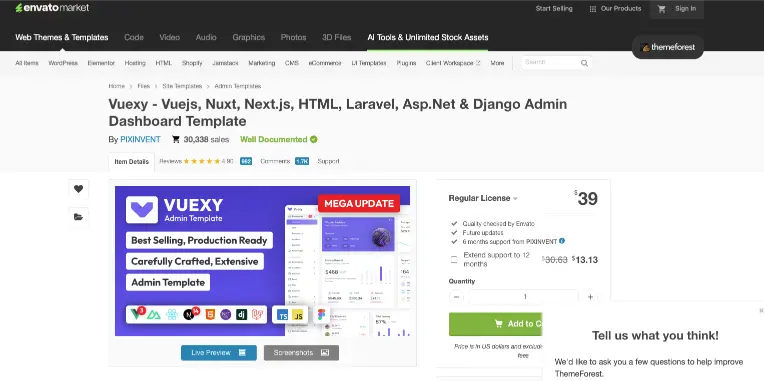
Vuexy is a multi-framework admin template by PixInvent on ThemeForest, with HTML, Laravel, .NET, Django, Vue, and Next.js versions.
The HTML, Laravel, .NET, and Django builds use Bootstrap 5 and Laravel 12. Vuexy has passed 30,000 sales. For more dashboard options, see Technext’s roundup of SaaS admin dashboard templates.
Features
- Versions for Vue, Next.js, HTML, Laravel, ASP.NET, and Django
- HTML and Laravel builds on Bootstrap 5 and Laravel 12
- 5 niche dashboards and 10 prebuilt apps, including email, chat, calendar, Kanban, ecommerce, invoice, and roles and permissions
- 15+ front pages, unlimited color options, and dark and semi-dark layouts
- JWT authentication and access control ready, plus fuzzy search, bookmarks, and a floating navbar
- 6 months of support and lifetime updates
Price
$39 for the Regular license on ThemeForest. The Extended license is $799 for products that charge end users.
Pros and Cons
How to integrate into Laravel
Vuexy includes a Laravel version, so you install it directly:
- Download the Vuexy Laravel build from ThemeForest.
- Install PHP dependencies with Composer and the front-end packages.
- Configure the .env file and the database.
- Serve the app through a local server such as XAMPP or the built-in Laravel server.
For the Vue version, Laravel runs as the API while Vue handles routing and authentication, so plan for two layers.
7. MaterialPro
Overview
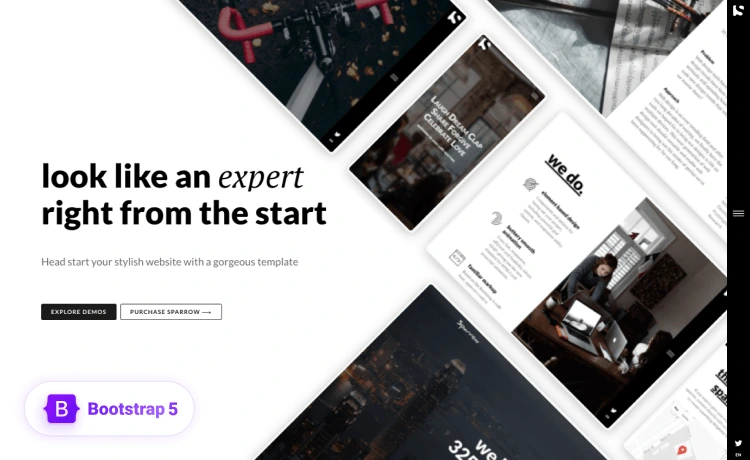
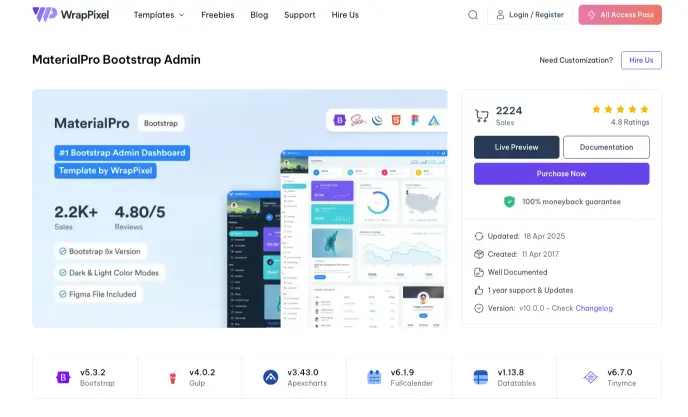
MaterialPro is a Bootstrap 5 admin template by WrapPixel that follows Material Design.
It includes 500+ pages, 12+ prebuilt apps, and 500+ UI components, and it uses jQuery. WrapPixel offers separate Angular, React, Vue, Next.js, and Tailwind editions, and MaterialPro has passed 2,000 sales. For a free Material Design starting point, see ThemeWagon’s free MUI dashboard templates.
Features
- Bootstrap 5 with Material Design styling, jQuery-based
- 500+ page templates and multiple demo and dashboard variations, including Mini-sidebar and RTL
- 12+ apps, including calendar, chat, contact, email, invoice, notes, Kanban, and ecommerce
- 500+ UI components and 3,400+ font icons
- ApexCharts, DataTables, TinyMCE, and FullCalendar
- Documentation and Figma included
Price
$49 for the Single Use license, which covers one end product with no user fees. Higher tiers cover multiple products and SaaS use.
Pros and Cons
How to integrate into Laravel
MaterialPro ships as Bootstrap HTML, so you port it into Blade like Phoenix and Falcon:
- Copy the assets into Laravel’s public directory, or route them through Vite.
- Build a master Blade layout for the header, sidebar, and footer.
- Split the pages into Blade views that extend the layout.
- Swap asset paths with asset() or @vite() helpers.
- Bind dynamic data through Blade variables and loops. The jQuery plugins load as standard scripts in the layout.
Why Choose ThemeWagon
Phoenix, Falcon, Aurora, and Falcon React come straight from ThemeWagon, so the source code, the support, and the updates all sit with one team.
- Direct support from the developers who wrote the code, not a reseller
- Figma files bundled with each template for design handoff
- One year of free updates on every license
- Clean Bootstrap 5 and React 19 codebases, with no jQuery on the Phoenix and Falcon React builds
- One $59 Standard license per template, with the same tier structure across the range
The four cover both stacks in this list: Phoenix and Falcon for Bootstrap HTML ported into Blade, Aurora and Falcon React for a React frontend on a Laravel API or Inertia. Browse the full range in the ThemeWagon theme index.
Hire Developers to Customize Your Template
If you face any issues implementing the templates for your Laravel projects, you can get back to the original creator, Technext & ThemeWagon. You can hire their dedicated team members on an hourly or monthly retainer model.
Technext is one of the best offshore development companies. They have been offering offshore software development, web app & mobile app development, and staff augmentation since 2012. Their engineers, especially full stack developers, backend developers, front-end developers, and UI/UX designers, are helping Nasdaq-listed companies, energy startups, insurance startups, and big enterprises across the US, UK, Canada, Europe, and Australia.
You can find a great developer who has hands-on experience and has implemented and sustained a lot of projects easily through them. So get in touch with the Technext team or ThemeWagon team to hire an offshore software development agency.
FAQ
Do these templates work with Laravel?
Yes. Metronic and Vuexy ship a Laravel version, and the Bootstrap HTML templates port into Laravel’s Blade layer.
Which templates include a ready Laravel version?
Metronic and Vuexy include a dedicated Laravel build. The others arrive as HTML, Bootstrap, or React code for Blade porting or API use.
Are any of these dashboard templates free?
No. All seven are paid, with prices from $39 to $59.
How do React templates connect to Laravel?
Laravel runs as the backend through a REST API with Sanctum, or through Inertia.js for direct page rendering. The React frontend reads the data from Laravel.
What goes into launching a Laravel dashboard?
Set up the views, data, authentication, and tests, then check links and performance before going live.
Final Thoughts
The seven templates split by stack and vendor: four ThemeWagon templates in Phoenix, Falcon, Aurora, and Falcon React, plus Metronic, Vuexy, and MaterialPro.
For a Bootstrap dashboard ported into Blade, Phoenix and Falcon hold the largest component sets. For a React frontend, Aurora and Falcon React fit an API or Inertia setup. For a ready Laravel install, Metronic and Vuexy ship Laravel builds, with Vuexy at the lowest price. MaterialPro suits a Material Design look on Bootstrap.
Match the template to your stack and budget, then plan the Blade, data, and authentication work before you start.